
![]() |
|
|
AirEqualizer and Hidden Nodes: A Real Solution to a Virtual ProblemContents
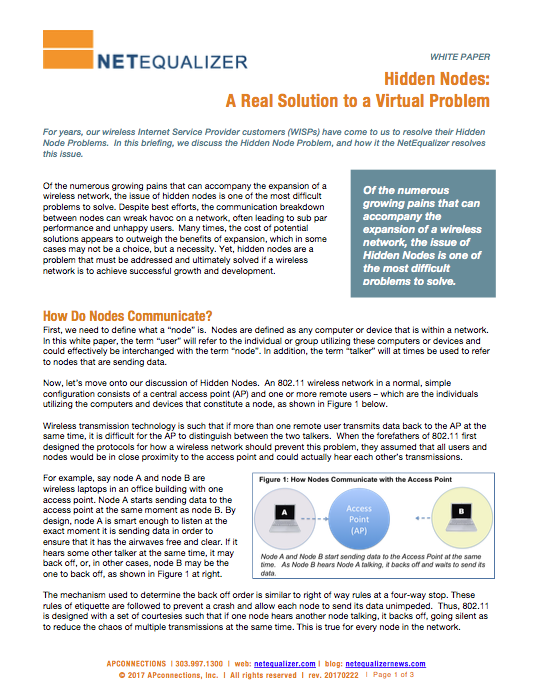
Of the numerous growing pains that can accompany the expansion of a wireless network, the issue of hidden nodes is one of the most difficult problems to solve. Despite your best efforts, the communication breakdown between nodes can wreak havoc on a network, often leading to sub par performance and unhappy users.1 Many times, the cost of potential solutions appears to outweigh the benefits of expansion, which in some cases may not be a choice, but a necessity. Yet, hidden nodes are a problem that must be addressed and ultimately solved if a wireless network is to achieve successful growth and development. What is a hidden node and why is it a problem for wireless networks? An 802.11 wireless network in a normal, simple configuration consists of a central access point (AP) and one or more remote users – which are the individuals utilizing the computers and devices that constitute a node. Wireless transmission technology is such that if more than one remote user transmits data back to the AP at the same time, it is difficult for the AP to distinguish between the two talkers. When the forefathers of 802.11 first designed the protocols for how a wireless network should prevent this problem, they assumed that all users and nodes would be in close proximity to the access point and could actually hear each other’s transmissions. For example, say node A and node B are wireless laptops in an office building with one access point. Node A starts sending data to the access point at the same moment as node B. By design, node A is smart enough to listen at the exact moment it is sending data in order to ensure that it has the airwaves free and clear. If it hears some other talker at the same time, it may back off, or, in other cases, node B may be the one to back off. The exact mechanism used to determine the back off order is similar to right of way rules at a four-way stop. These rules of etiquette are followed to prevent a crash and allow each node to send its data unimpeded. Thus, 802.11 is designed with a set of courtesies such that if one node hears another node talking, it backs off, going silent as to reduce the chaos of multiple transmissions at the same time. This should be true for every node in the network. This technology worked fine until directional antennas were invented and attached to remote nodes, which allowed users to be farther away from an access point and still send and receive transmissions. This technology is widely available and fairly inexpensive, so it was adapted by many wireless service providers to extend Internet service across a community. The impact of these directional antennas, and the longer distances it allows users to be from access points, is that individual nodes are often unable to hear each other. Since their antennas are directed back to a central location, as the individual nodes get farther away from the central AP, they also become farther apart from each other. This made it more difficult for the nodes to communicate. Think of a group of people talking while they stand around in an ever-expanding circle. As the circle expands away from the center, people get farther apart, making it harder for them to communicate. Since it’s not practical to have each node point a directional antenna at all of the other nodes, the result is that the nodes don't acknowledge one another and subsequently don’t back off to let others in. When nodes compete to reach the access point at the same time, typically those with the strongest signals, which are generally closest to the AP, win out, leaving the weaker-signaled nodes helpless and unable to communicate with the access point (see image below).
When a network with hidden nodes reaches capacity, it is usually due to circumstances such as this, where nodes with stronger signals steal the airwaves and crowd out nodes with weaker signals. If the nodes with the stronger signals continue to talk constantly, the weaker nodes can be locked out indefinitely, leaving certain users without access to the network. The AirEqualizer solution, which is completely compatible with 802.11, works by taking advantage of the natural inclination of Internet connections to back off when artificially restrained. We'll get back to this key point in a moment. Understanding the true throughput upper limit of your access point is key to the AirEqualizer’s efficiency, since the advertised throughput of an AP and its actual ceiling often vary, with most AP's not reaching their full potential. Once you have determined the peak capacity of the access point (done empirically through busy hour observation), you then set the AirEqualizer effective trunk size to that value. This tells the AirEqualizer to kick into gear when that upper limit is reached. Once configured, the AirEqualizer constantly (every second) measures the total aggregate bandwidth throughput traversing the AP. If it senses the upper limit is being reached, AirEqualizer will then isolate the dominating flows and encourage them to back off. Each connection between a user on your network and the Internet constitutes a traffic flow. Flows vary widely from short dynamic bursts, which occur, for example, when searching a small Web site, to large persistent flows, as when performing peer-to-peer file sharing or downloading a large file. By keeping track of every flow going through the AP, the AirEqualizer can make a determination of which ones are getting an unequal share of bandwidth and thus crowding out flows from weaker nodes. AirEqualizer determines detrimental flows from normal ones by taking the following questions into consideration: 1) How persistent is the flow? How do you know congestion is caused by a heavy stream? We have years of experience optimizing networks with this technology. It is safe to say that on any congested network roughly 5 percent of users are responsible for 80 percent of Internet traffic. This seems to be a law of Internet usage.2 Can certain applications be given priority? APconnections is a privately held company founded in July 2003 and based in Lafayette, CO. We develop cost-effective and easy-to-install and manage traffic shaping appliances. Our NetEqualizer product family optimizes critical network bandwidth resources for any organization that purchases bandwidth in bulk and then redistributes or resells that bandwidth to disparate users with competing needs. Our goal is to provide fully-featured traffic shaping products that are simple to install and easy to use and manage. We released our first commercial offering in July 2003, and since then over 1000 unique customers around the world have put our products into service. Our flexible and scalable solutions can be found at ISPs, WISPs, major universities, Fortune 500 companies, SOHOs and small businesses on six continents.
|